
Don't judge the witch
Robert Eggers and getting the fate you want

October always sneaks up on me simply by being itself. Is it really this spooky, on a twilit walk home from the library? Am I just giving in to the marketing implicit in all those front-lawn skeletons? Is the evening light really this slanted, this portentous, this off? Isn’t this all a cliche? Nothing, month or otherwise, should so tidily meet expectations.
There’s no use fighting against the falling of the leaves. This newsletter is devoutly vibes-driven. So in the dusky light of October, and in a continuation of my habit of writing about dark magic, I wanted to talk about the distinctive storytelling in the movie that launched the career of Robert Eggers: The Witch (2015).
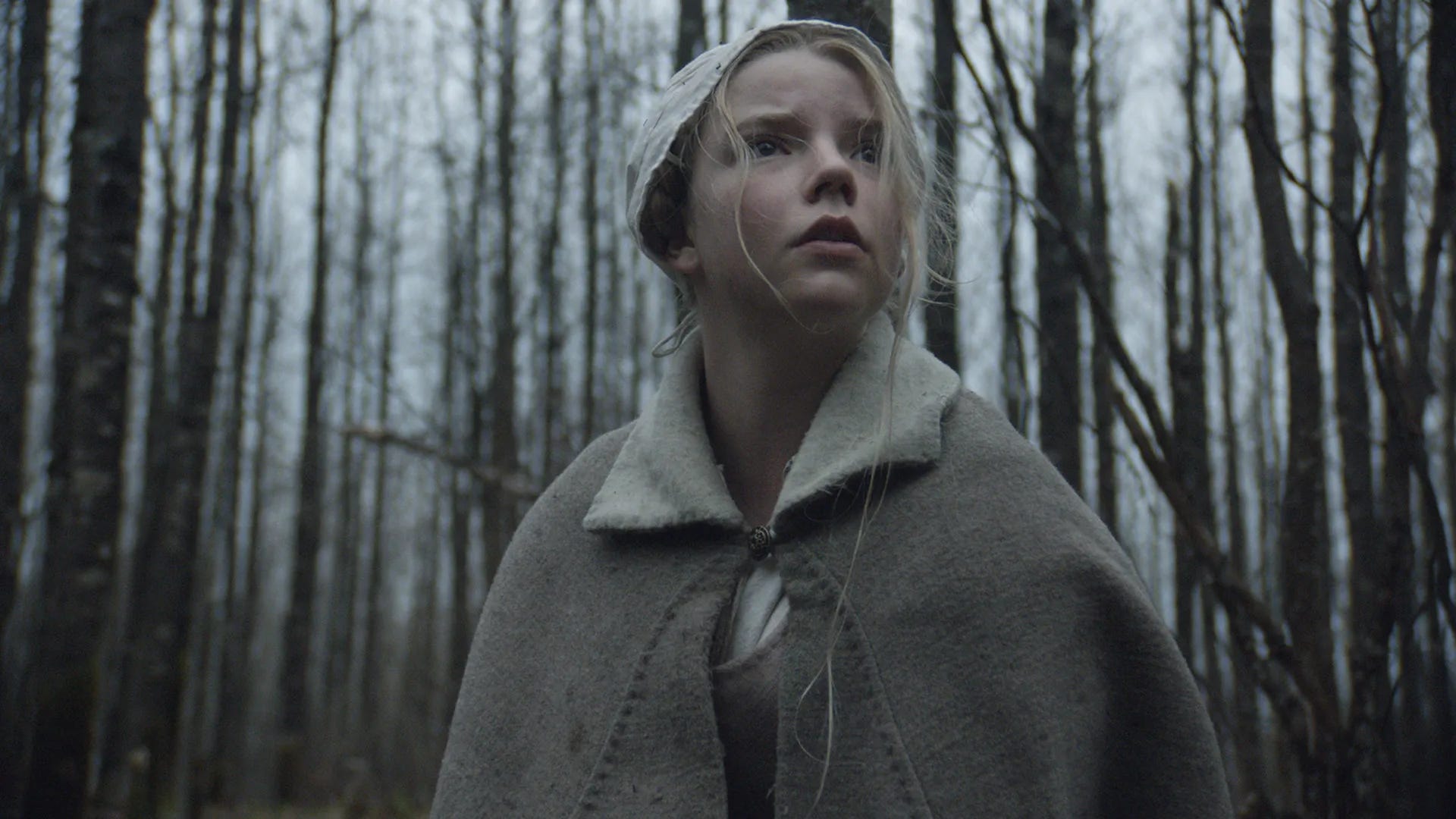
The Witch is the kind of debut any artist would envy: A movie bold-faced1 enough to be widely legible, but distinctive enough to be surprising. It was also a pretty solid hit by indie horror standards. One imagines that The Witch earning $40 million against a mere $4 million budget is one reason Eggers’s career weathered the relative commercial flops of The Lighthouse (2019; I did not like this one much) and The Northman (2022; I love this one) before Nosferatu (2024) brought him back to the ranks of bankable directors. So by what alchemy did The Witch take Eggers from an indie striver to someone who gets real budgets for his adventures in the macabre?
The Witch takes place in Massachusetts in the 1630s. Thomasin (Anya Taylor-Joy) is the eldest daughter of a family of English-immigrant Puritans so pure that they’re exiled from their town for something like preaching the gospels too purely. Finding themselves on the edge of the frontier (deep, dark woods), Thomasin’s family try to scrabble a living out of the earth. But things start going wrong. The crop mostly fails. The hens aren’t a’laying. And then the infant of the family is stolen away, by a wolf or something more sinister, and Hell literally begins to break loose.
If you’ve seen any of Eggers’s movies, you’ll have guessed that he’s a fan of Greek tragedy, Early Modern tragedy, tragedy in general. Things happen to his characters and no amount of railing and thrashing and headstrong-ness can spare them from their overdetermined fates. Eggers also wants all his dialogue to go something like this, from The Witch:
William [father]: Dissemblers! Grave pretenders all. Hear me this: I will not play a fool to children’s games!
Katherine [mother]: This is no sport William.
William: Yet these lies from our babes’ mouths are but trifles to them.
Thomasin: I do not lie!
This is how characters communicate in Eggersland: Solemn, laden with purpose and conviction. The key to making it work in his movies is that Eggers knows how to conjure a strange, foreboding realm in which incantatory, pre-modern language feels at home. In The Witch, the woods around the family farm indeed throb with gravid menace.
And not to spoil anything, but there very much is a witch in the woods. Although this is another interesting Eggers choice: The particular witch in the woods—who steals Thomasin’s infant brother from under her nose and, well, does away with him—is in fact not particular. She appears a few times in different guises, but by the end, there are other witches and it’s unclear which she might be. There’s no backstory, no character development, not even a name. Another Eggers trademark: Characters exist in the midst of primal, irresistible, often malevolent forces. A sense of self is a delusion, a vanity to be stripped away by violence and loss.
It turns out that the big bad is not the witch in the woods but rather a farm animal. Black Phillip the family billy goat is revealed to be the Devil himself. The younger children, Jonah and Mercy, have been claiming that the goat was speaking to them all along. Turns out they weren’t lying. It’s The Prince of This World in the flesh, and he’s here to creep on teenaged girls:
By the time this scene happens, Thomasin’s family have all been slain by witches, the Devil, and each other. She’s a member of a banished and now annihilated household. If she did go to seek help, she might not even know where to go, and whoever came to her aid would find mayhem and murder and one survivor—a young woman in a society always searching for witches to blame.
So what is she to do? She’s always wanted to get away from her mother, who seems to hate her, and from the meager wages of her father’s austere zealotry. She wanted to go back to England, where things were better. She wanted to be with her dead brother, who really did love her (to the point of eroticism creeping in). She wanted a lot of things. Now the Devil is telling her she can at least be spared starvation or hanging. She signs his book and walks naked into the woods, where she joins a howling coven of witches.
In the final scene, Thomasin is consumed with the dark ecstasy of the coven. Should we say she’s happy? I think so. Because this is the brilliance of The Witch: Thomasin’s fate is to be at the center of an accursed, satanic vortex of blood and cruelty. But she also never wanted to be the self-sacrificing Puritan daughter. Is it her fault that she doesn’t know what else she wants, that she couldn’t get it even if she did, that a deal with the Devil doesn’t seem so bad? Can we blame her if she takes joy in escape, however dark? Can we blame someone for loving their fate?
These are less easily answerable moral questions than we’d like them to be. This rich ambivalence is what Eggers does so well: His characters want things, but they don’t really seem to have choices—or do they? We can at least say they don’t have choices that are familiar to us. We live in a more mundane reality and we don’t always talk like Sophocles characters. In a movie like The Witch, judgement comes second to the mad spectacle. We get to watch, as a friend of mine put it, Eggers’s protagonists getting everything they wanted and then immediately going to Hell.
Calvin and Hobbes Corner
I guess this is pretty deep:
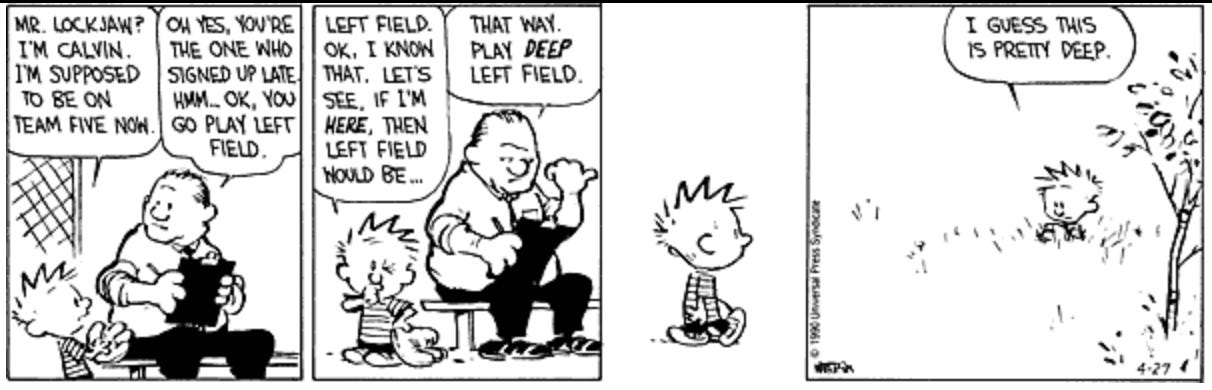
It’s rare in Calvin and Hobbes that we get to meet a one-off character. Watterson could have had Calvin trotting around to stores in the mall, movie theaters, wherever comic strip protagonists go. He could have gone out and had embarrassing interactions with all kinds of grownups. Yet Calvin’s world is circumscribed, not only because he’s six, but because he doesn’t really want to do anything other than hang out with his fuzzy buddy. The field where Mr. Lockjaw exiles him is, fittingly, the kind of place he willingly wanders with Hobbes.
OK, it must be said: It’s a bit eerie to stumble across the macho, severe Mr. Lockjaw and discover that he shares a (ludicrous) surname with Sean Penn’s bad guy in the movie of the moment, One Battle After Another. Coincidence? I think not. We have to imagine Paul Thomas Anderson taking inspiration from a Bill Watterson character who appears in all of two panels. Such is the gravitas of Mr. Lockjaw, who is a convincing composite of every Old Ball Coach on record.
A Poem
Edna St. Vincent Millay is learning fairy-tale hands.
Like Paul Schrader, Eggers doesn’t really do subtle. And come to think of it, they have a comparable Calvinist streak.
I love the Northman too and was confused by how it was received. Arguably the best Conan movie we'll ever get
VVitch posting is the best posting